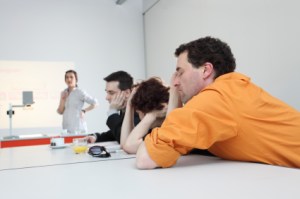
Right Brain … Right Meeting


The New York Times recently featured an article about how tapping into the power of the right brain can enhance meetings and improve productivity. The point of the article was simple; if you want to spur creativity, capture and hold attention, and promote innovation and interaction, you need to create a space that stimulates the creative, social side of the brain – the right side.

The left side of the brain is all about linear stuff – spreadsheets, lists, agendas and outlines. It’s predictable, straightforward – and to most people, boring. On the other hand, the right brain thrives on non-linear activity – games and play, unusual activities, and non-predictable interactivity. It’s fun, engaging and creative. So how do you tap into your team’s right hemispheres?

Here are a few tips from the experts:

Keep them moving
“People tend to shut down if they can’t get up and move around,” notes Stacy Evans, executive administrator at Cisco Systems. Break up your meetings with games, stretching breaks, physically active exercises and other activities. Or hold the meeting outside in a beautiful setting and walk while you talk, stopping for breakaway sessions and rest periods as needed.

Get comfortable
“Hard wooden chairs don’t do it anymore,” says Meeting Professionals International chief executive Bruce MacMillan. Instead of a bunch of hard seats around a conference table, hold your meeting in a setting comprised of several small and comfortable seating arrangements. Not only will this help you keep your participants attention on the meeting (instead of their aching rear ends), it’ll help promote conversation and breakaway groups.

Have fun
Play is a great way to stimulate the right side of the brain. It can be as simple as putting toys out on the tables or as complicated as a day-long scavenger hunt. No matter what level you choose, injecting play into your meeting will help participants tap into their creative energy, cross-pollinate ideas and relax into broader, more innovative thinking.

Enhance sensory input
Create a sense-stimulating environment to really rev up right-brain thinking. Colorful furnishings, art, live flowers, unusual foods and beverages, music, aromatherapy – all these things can turn on participants senses and turn up their creativity. The human mind is like any other thinking machine – the greater and more diverse the input, the better and more interesting the output.

Mix it up
Keep your participants’ minds from getting stale by mixing up activities. Have a sit-down discussion in the morning over breakfast, then break out into walking discussion groups in the afternoon. Reconvene after dinner for an evening of games and creative brainstorming. On day two, start the day with a guided meditation, then split off into conversation groups to continue yesterday’s discussions. The less predictable and more interesting the schedule, the more likely you are to jog loose something wonderful.

Bringing the right side of the brain into your meetings may mean using unfamiliar methodology, but the results can be incredible. Speaking about a sales conference that netted a 40 to 50 percent increase in sales (significantly above the normal “conference boost”), GroupSystems product management senior director Diana Peterson said, “It was about getting people in the right frame of mind…breaking down barriers, getting people talking and making decisions they might not make because maybe they feel more daring.” And that’s a result worth getting excited about.
Posted in Uncategorized | Tagged , , , , | Leave a comment

Seven Sins of Deadly Meetings …


I read an article years ago in Fast Company magazine about the Seven Sins of Deadly Meetings.  I always liked the way the author, Eric Matson, crafted the title.  He didn’t say ‘the seven deadly sins’, but rather ‘the seven sins of deadly meetings’. I could probably add another hundred sins to the deadly meetings I have survived. I thought if you haven’t seen this list, it would be good to share because it still holds true:

#1 People don’t take meetings seriously. They arrive late, leave early, and spend most of their time doodling.

#2 Meetings are too long.  They should accomplish twice as much in half the time.

#3 People wander off the topic. Participants spend more time digressing than discussing.

#4 Nothing happens once the meeting ends. People don’t convert decisions into action.

#5 People don’t tell the truth.  There’s plenty of conversation, but not much candor.

#6 Meetings are always missing important information, so they postpone critical decisions.

#7 Meetings never get better.  People make the same mistakes.

Bernard DeKoven’s quote at the end of the article really sums things up: “People don’t have good meetings because they don’t know what good meetings look like.  Good meetings aren’t just about work. They’re about fun — keeping people charged up.  It’s more than collaboration, it’s ‘coliberation’ — people freeing each other up to think more creatively.”

Somewhere between an unforgiving, structured agenda and a free-for-all, there is creativity. As a meeting leader it is our job to tap into that sweet spot of liberation and capture those gems of creative thinking. Increased productivity cannot happen in a stifled environment. PLAY is not a four-letter word and FUN is not the enemy. Take a little advice from Plato, who must have been a fun guy, and said:

      “You can discover more about a person in an hour of play than in a year of conversation.”

So, enough with the talk, talk, talk, and deadly meetings. It’s time to get down to business and PLAY!

(If you’d like to read the entire article, The Seven Sins of Deadly Meetings, here’s the link http://www.fastcompany.com/magazine/02/meetings.html

Posted in Uncategorized | Tagged , , , , | Leave a comment

Talk to the hand …


On Seinfeld, when George didn’t want to hear what Jerry was trying to tell him, he would throw his hand up and say ‘Talk to the hand, Jerry!’. What he was really trying to say was shut the hell up, you’re killin’ me, I’ve heard it all before! This is exactly my sentiment when forced to sit through a meeting on a topic upon which I have sat before.

In my past life (for those who know me, no, not that one), I worked for the same company for six years.  And every year around the same time I would be scheduled to attend a meeting on performance appraisals. Why we do them, how to write them, how to deliver them and how not to get the company sued by screwing up any of the former. I would sit in the room with my co-workers and listen to the same consultant tell the same stories, and follow the same agenda we had all listened to for the last oh-so-many years. And I use the phrase ‘listened to’ because there was no ‘learned from’.

This is a fatal flaw that organizations perpetuate. I am certainly not discounting the importance of being trained on performance appraisals. My issue is with how this training was delivered. For first time attendees, great, it should be a required course. In subsequent years, for those who are still on the farm, I would recommend a pre-training assessment to validate that the previous training stuck. It’s easy to do a quick online quiz and develop your mandatory attendance list from the results. Every meeting is not for every available person. Consider the content and the competency of the attendee.

Lack of employee productivity costs businesses millions of dollars each year. How we did things last year may not work again this year. Make the effort, get out of the recycle-the-meeting rut, and create a compelling learning experience for the right people. Then perhaps the only ‘hand’ you’ll get is the clapping kind.

Posted in Uncategorized | Tagged , , , , , | Leave a comment

Meetings don’t suck … presenters do!


I attended a meeting recently to observe the facilitator and to provide coaching tips. My first challenge was just staying awake long enough to take notes. This person could qualify for the next miracle sleeping aid. It would not have mattered how exciting the content was, the delivery was painful and the result was a room full of hopeful attendees who were driven to making their grocery lists and checking their emails.

This is a management problem masquerading as a bad presenter.  In this particular instance, the direct manager recognized the need for presentation skills for his employee, and took action. But often it is easier to allow untrained, unprepared individuals to waste the time and productivity of fellow co-workers. Nobody wins with that decision. Meetings are not one-on-one discussions; they can involve hundreds of attendees. A poor presenter can suck all the excitement out of a room, diminish the overall intended message, and waste precious time for everyone.

Invest in your employees who you rely upon to communicate your message. It is a reflection on you as a manager if your employee does not have the skill to do their job. Training is essential and most companies have good trainers available to provide all forms of communication skills training.  Use them, or find a resource to address the problem.  Ignoring it doesn’t make it go away and is unfair, and costly, for the employee and the company.  It would also help if  you take care of it before I have to sit through their next meeting. I’m all caught up on my sleep.

Posted in Uncategorized | Tagged , , , , , | Leave a comment

I hate meetings!!!


You can’t bore someone into learning, but we’ve all slept through our share of meetings and seminars where they have given it their best shot. The unintended consequence of a poorly planned and executed meeting can prove more harmful than the obvious lack of learning.  Frustration, ill will, and resentment are often the result of having to sit through a tedious training seminar or meeting. And most of us would rather be someplace else.

So, make it fun. Bring the creativity on. Management needs assurance that the investment in meetings will pay high dividends. Make it happen. Nature designed play to be the ultimate learning experience. Play is a good thing and interaction will yield far greater results than a static, one-dimensional meeting.


Posted in Uncategorized | Tagged , , , , , | Leave a comment

PLAY is not a four-letter word …


There is a tendency to think of games in terms of play, where play is the opposite of work, and work is, well, work. To understand the concepts underlying corporate games, we need to rethink these notions.

Work is a state of mind! What is work to someone else, may be child’s play to you. So, instead of perceiving the task as labor, toil and drudgery, your experience in its accomplishment might be enjoyable, satisfying and, oh no, fun. Work, as it relates to people, is not an absolute. Acceptance of this idea allows us to consider that perceptions of work may be altered because work is truly just a state of mind.

The view that play and work are at the opposite ends of the continuum, is an error in thinking that makes going to work a bore, and staying at work a bigger bore.  Play is not a four-letter word. Bore is. Knock it off.

Posted in Uncategorized | Tagged , , , , | Leave a comment